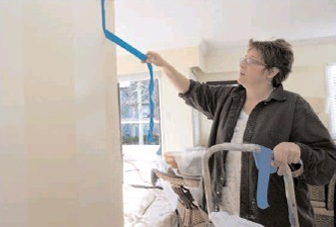
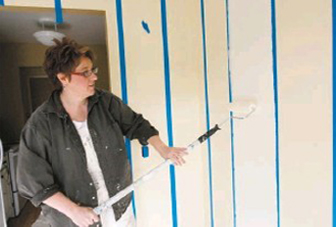
Leah Langefeld shows how to paint, and remove tape, like a pro.On the surface, painting seems like an easy thing to do. After all, anybody who can move their arms back and forth can paint.
It’s a nice idea, but house painting takes a lot of practice before you can achieve the same results as a professional. Still, it is possible for do-it-yourselfer homeowners to paint like a pro — but be warned, it will take time. We asked the experts for some tips for success, so you can avoid the pitfalls that plague hasty homeowners. “The most important advice I can give is to use the right paint for the job,” says Jason Lehman, branch manager at the Victoria location of Cloverdale Paint. “When customers come in, I try to get as much information as possible to get the right paint for their project.”
The choices for the uninitiated can be daunting — flat, eggshell, semi-gloss, gloss, low or high sheen, etc. A professional will automatically know to use semi-gloss for the kitchen, for example. A room children use regularly would be best painted in an eggshell with a low sheen so that it can be easily cleaned and marks to the paint touched up. But the secret to a professionallooking room is not the paint but the preparation done long before a drop of paint touches the wall.
Painting a room is not as simple as paint by numbers, but Leah Langefeld, owner of Langefeld Painting and Wall Design, gives nine tips for a professional-looking paint job.
1. Keep it clean
Paint does not adhere to grease. Wash kitchen walls with TSP (Trisodium Phosphate), a heavy-duty cleaner or a mild detergent to remove dust, smoke and other dirt that may be on the walls and ceiling.
2. Know your surface
Latex paint won’t adhere to a surface previously painted with an oil-based paint. If in doubt, sand and prime the surface before applying water-based paint. Oil paint can be painted over water-based paint easily.
3. Prime
Window sills and walls with mould and mildew stains should be first covered with a shellac-based primer-sealer. This product seals, primes and blocks out stains.
When painting over a dark colour, it is best to prime the walls with a tinted primer first. Always prime walls that have been patched. Otherwise, the patched area will always show through the new paint.
If an unfinished spray texture ceiling, or popcorn finish, is to be painted, it’s best to use an oil-based primer instead of latex.
4. Tape it up
Use painter’s tape instead of ordinary masking tape. The latter leaves a residue and, more often than not, peels dried paint as well when removed. When taping around baseboard mouldings, use low-tack tape on the floor. These delicate tapes are ideal for long-term masking jobs.
5. Dust is the enemy
Cleanness is a virtue. It’s a good idea to clean and vacuum the room before painting. Moving about kicks up dust and that dust will find its way onto wet surfaces.
6. Use better equipment
Sometimes the main reason a professional’s job looks better is because they use better equipment. Good-quality brushes deliver a smoother finish and make painting tasks easier.
7. Use better paint
“You just have to paint a lot more coats with cheaper paint,” says Langefeld. “They tend to drip and have less hiding capability.” Cloverdale Paint’s Lehman agrees. While prices are the largest driving issue for consumers, premium paints clean up easier, are more durable and, if damaged, touch up better.
8. Don’t be afraid to use oil-based paint
Many people avoid using oilbased paints because of the need of solvents to clean the brushes and their strong smell.
Some manufacturers have responded by introducing low-VOC (Volatile Organic Compound) oil paints.
9. Clean it up
Use razors instead of scrapers to clean up paint on windows. Use a painter’s drop cloth or old sheets to protect furniture and floors.
This article was featured in the following newspapers
- Victoria Times Colonist
- Vancouver Sun
- Regina Leader Post
- National Post
- Ottawa Citizen